Prodromal RBD Risk Stratification
Population-level risk model identifying prodromal neurodegeneration from wrist actigraphy
UK Biobank Cohort Study · June 2025
Challenge
REM Sleep Behavior Disorder (RBD) is a parasomnia strongly associated with prodromal alpha-synucleinopathies, particularly Parkinson's disease and dementia with Lewy bodies. Up to 80% of individuals with idiopathic RBD will phenoconvert to a neurodegenerative condition within 10–15 years.
The challenge: How can we identify individuals at highest risk of phenoconversion using passively collected, non-invasive data at a population scale?
Approach
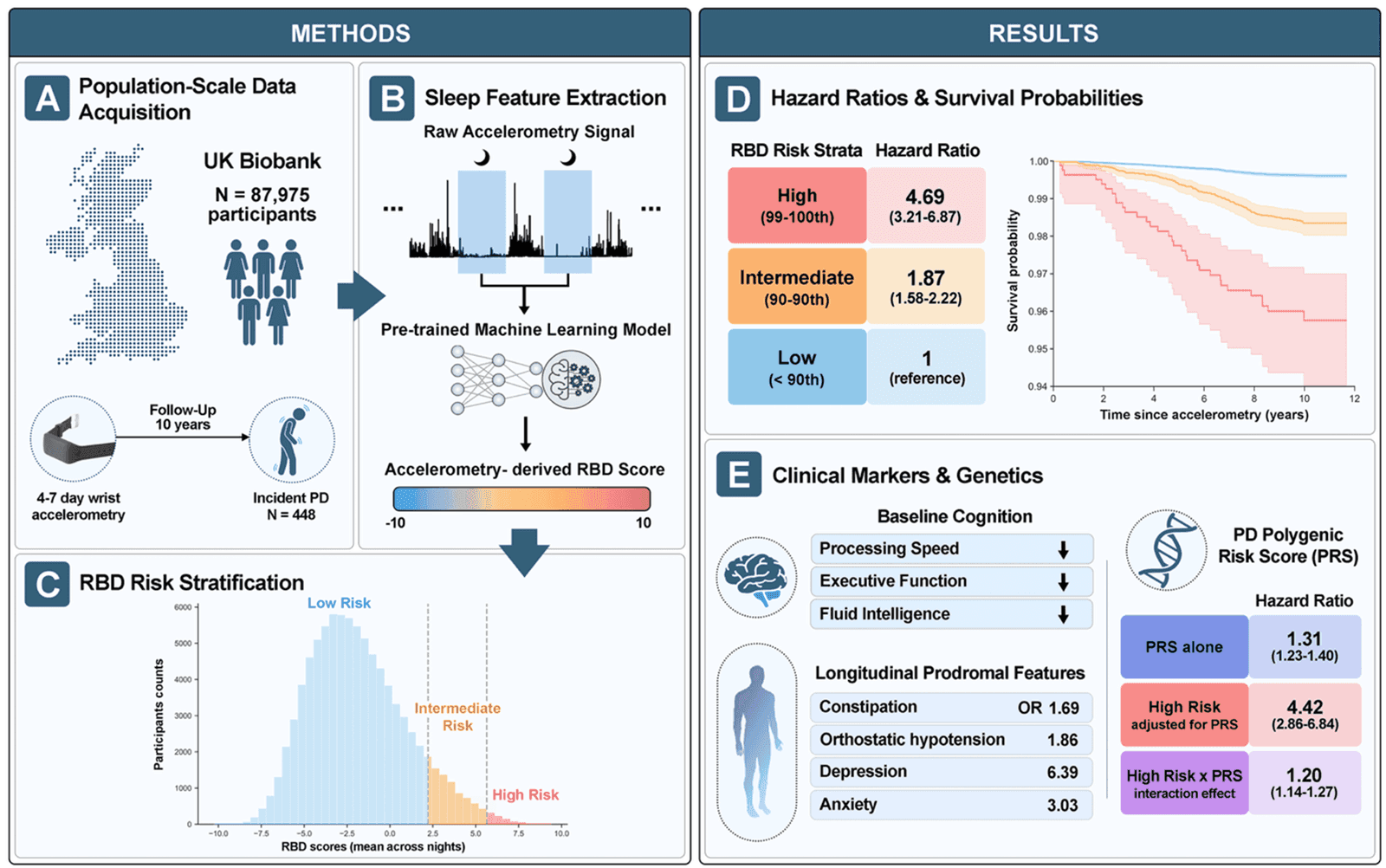
Using the UK Biobank cohort (N = 87,975 with 7-day wrist accelerometer data), we developed a validated machine learning classifier for REM Sleep Behavior Disorder (RBD) detection and assessed its association with incident Parkinson's disease over 10 years of follow-up.
Methods
- Cohort construction using UK Biobank participants with 7-day wrist accelerometer recordings and 10-year follow-up for incident Parkinson's disease
- Feature extraction from raw accelerometer data: RBD-specific patterns derived from nocturnal movement, sleep fragmentation, and actigraphy-derived sleep metrics
- Survival analysis (Cox proportional hazards model) to estimate hazard of incident PD across risk strata
- Risk stratification using percentile-based thresholds: highest-risk group (>99th percentile) vs lowest-risk group (0–90th percentile) on the RBD classifier score
- Validation dose-dependent relationship across full score distribution; association independent of PD polygenic risk score; RBD score and genetic risk synergistic
Results
The validated RBD classifier demonstrated strong discrimination for incident Parkinson's disease:
- Hazard ratio: Individuals in the highest RBD-risk stratum (>99th percentile) showed a 4.69-fold increased hazard of incident PD compared to the lowest-risk group (0–90th percentile)
- Dose-dependent relationship: Hazard increased monotonically across the full RBD score distribution
- Positive likelihood ratio: 7.91 (approximately threefold higher than questionnaire-based RBD screening)
- Genetic interaction: RBD score and PD polygenic risk score were synergistic; association independent of polygenic risk alone
Key Metrics
| Metric | Value | |--------|-------| | UK Biobank cohort | 87,975 participants | | Follow-up period | 10 years | | Model | Cox proportional hazards | | Contrast | >99th percentile vs 0–90th percentile RBD risk | | Outcome | Incident Parkinson's disease | | Hazard ratio | 4.69 (95% CI: 3.21–6.87) | | Positive likelihood ratio | 7.91 | | Status | Unpublished |
Takeaway
Wrist accelerometry-derived RBD detection achieved a 4.69-fold hazard ratio for incident Parkinson's disease in a population-scale UK Biobank cohort, with a positive likelihood ratio of 7.91 — threefold higher than questionnaire-based RBD screening. The dose-dependent relationship across the full score distribution and synergistic interaction with genetic risk support actigraphy as a non-invasive, scalable biomarker for prodromal neurodegeneration. This work demonstrates that passively collected wearable data carries clinically actionable signal for identifying individuals at elevated risk, supporting targeted screening and clinical trial recruitment strategies.