Optimizing ML Classification of Narcolepsy Type 1 Using Cataplexy Questionnaire & HLA Biomarker
ML-based screening pipeline enables 94% sensitive, 98% specific NT1 detection from brief questionnaire + genetic marker
Stanford Sleep Medicine Center, USA · March 2025
Challenge
Narcolepsy Type 1 (NT1) is a chronic neurological disorder caused by hypocretin deficiency, characterized by excessive daytime sleepiness and cataplexy—sudden episodes of muscle tone loss triggered by emotions. Accurate diagnosis in large-scale settings remains challenging due to NT1's low prevalence (~30 per 100,000), reliance on invasive testing (polysomnography, MSLT, CSF hypocretin assays), and diagnostic delays averaging 5–10 years from symptom onset.
In sleep clinics, rapid risk stratification is critical to prioritize severe patients for confirmatory testing while minimizing unnecessary referrals. Current screening tools (ESS alone, rule-based decision trees) lack the sensitivity and specificity needed to scale NT1 detection across diverse populations.
Approach
We developed machine learning classifiers trained on the Stanford Cataplexy Questionnaire and optional HLA-DQB1*06:02 genotyping to enable high-specificity NT1 risk stratification in clinical and population-based settings. The approach prioritizes specificity to reduce false positives in low-prevalence populations, then implements a post-hoc veto rule to correct any predicted NT1 cases lacking the HLA biomarker, further improving diagnostic precision.
The framework was designed for immediate clinical adoption: it uses only self-reported symptom data (emotional triggers for cataplexy, specific muscle weakness patterns) plus an optional genetic test, eliminating dependence on costly MSLT or sleep studies for initial triage.
Methods
- Study cohort: 1,207 adults (280 NT1 cases, 927 controls with other sleep disorders) from Stanford narcolepsy database, all with confirmed ICSD-3-TR diagnoses
- Feature sets: 27-item full cataplexy questionnaire vs. 10-item reduced set (matching UK Biobank) with/without HLA-DQB1*06:02 genotyping
- Key cataplexy features: Emotional triggers (laughter, joking, anger, excitement) and muscle weakness locations (knees, head, jaw, speech, hands)
- ML models: Six classifiers (SVM, Lasso, Elastic Net, LDA, LightGBM, XGBoost) trained with nested 10-fold cross-validation and Optuna hyperparameter optimization
- Optimization: Prioritized specificity (>98%) given low NT1 prevalence; applied post-hoc HLA veto rule to suppress false positives in non-HLA feature sets
- Validation: Evaluated at three operating thresholds (default τ=0.5, Youden's J-maximizing, and maximum specificity)
- Feature importance: SHAP analysis identified laughter and joking as dominant predictors (>20% contribution), followed by head drooping and knee buckling
Results
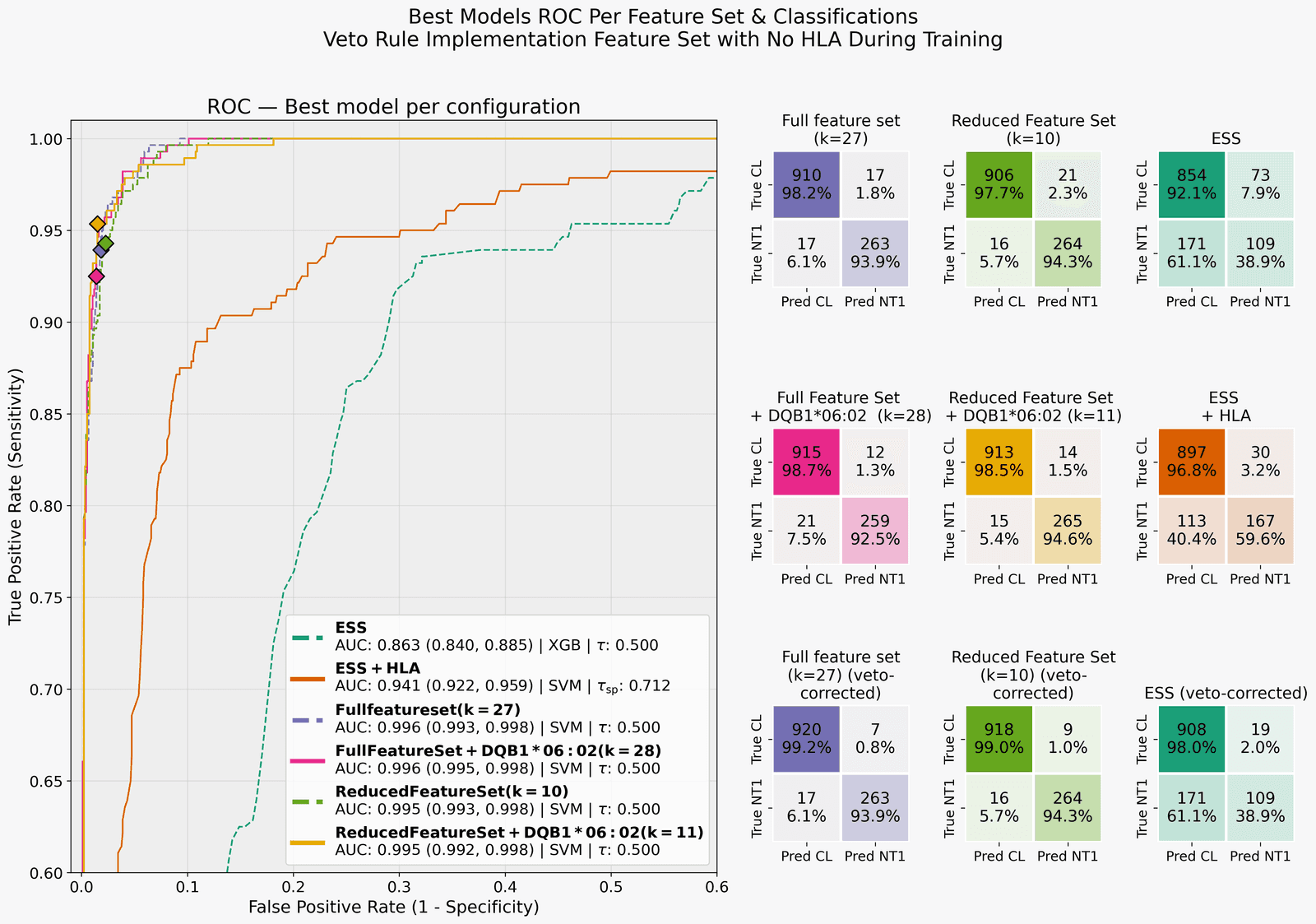
Full cataplexy questionnaire (k=27) without HLA achieved near-perfect discrimination:
- AUC: 0.9955 (95% CI: 0.9950–0.9998)
- Sensitivity: 94.85% (at Youden's J threshold; 93.55% for reduced 10-item set)
- Specificity: 98.05% (97.9% for reduced set)
- Positive Predictive Value (PPV): 1.51% (non-HLA), improving to 3.6% with HLA + veto rule at population prevalence
Adding HLA-DQB1*06:02 (present in 91.8% of NT1 cases vs. 24.6% of controls) increased specificity to 99%+ with zero false positives in full feature set. The post-hoc veto rule further improved specificity without sacrificing sensitivity, reducing false positives from 81 (ESS-only model) to near-zero.
The 10-item reduced questionnaire (designed for scalability in large cohorts like UK Biobank) performed comparably:
- AUC: 0.995 with HLA
- Sensitivity: 94.6%
- Specificity: 98.2%
Key Metrics
| Metric | Full Feature Set (k=27) | Reduced Set (k=10) | |--------|------------------------|--------------------| | AUC | 0.9955 | 0.995 | | Sensitivity | 94.85% | 94.62% | | Specificity | 98.05% | 98.24% | | NPV | ≥0.99998 | ≥0.99998 | | Model specificity with HLA veto rule | 99%+ | 99%+ | | Training cohort | 1,207 (280 NT1) | 1,207 (280 NT1) |
Takeaway
This work demonstrates that a brief 10-item cataplexy questionnaire, analyzed via machine learning and optionally paired with HLA genotyping, can reliably identify high-risk NT1 patients for clinical confirmation. For sleep clinics, the approach enables:
Rapid risk stratification: Severe patients (exhibiting laughter-triggered cataplexy + focal muscle weakness + high ESS) are flagged for immediate MSLT priority, reducing diagnostic delays.
Diagnostic tool validation: Clinicians can assess questionnaire relevance in their patient population—comparing false positive rates, feature importance, and sensitivity at different thresholds.
Scalable screening: The reduced 10-item feature set integrates directly with large population cohorts (UK Biobank) and EHR systems, requiring no additional data collection beyond standard intake interviews.
False-positive reduction: HLA-DQB1*06:02 testing (if available) dramatically reduces unnecessary referrals while maintaining 94%+ sensitivity, making the tool practical for population-level use.
Future validation in independent cohorts, combined with wearable actigraphy or GWAS, may further improve positive predictive value for population-based screening initiatives.