Sleep Clinic Workflow Automation
Automated reporting pipeline eliminating 15+ hours of manual work per week
Anonymous Sleep Clinic · March 2025
Challenge
A multi-provider sleep clinic was spending significant clinician time on repetitive operational tasks: manually formatting polysomnography reports, reconciling scheduling data across platforms, and generating compliance documentation for referring physicians. These workflows were error-prone, time-consuming, and diverted clinical attention from patient care.
The clinic estimated that each provider spent 3+ hours per day on administrative tasks that could be systematically automated.
Approach
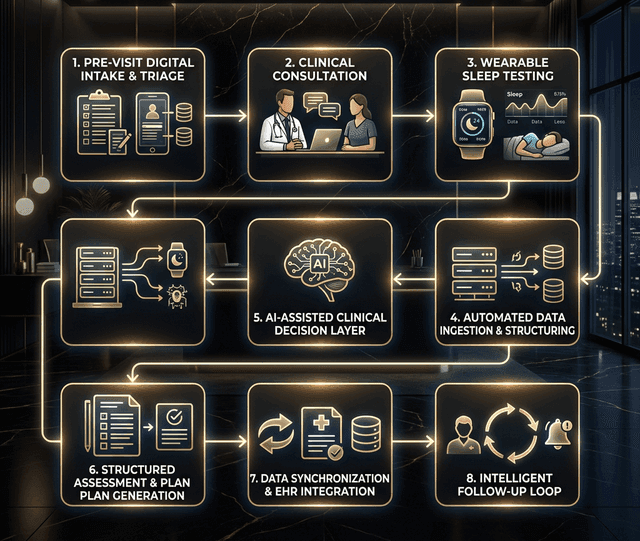
We conducted a comprehensive workflow audit to map every step of the clinic's operational pipeline — from patient intake to final report delivery. The goal was to identify automation opportunities that would preserve clinical quality while eliminating manual repetition.
Methods
- Process mapping of 12 distinct operational workflows across intake, scheduling, testing, reporting, and follow-up
- Bottleneck identification using time-motion analysis: report generation and scheduling reconciliation accounted for 68% of administrative overhead
- Automated PSG report pipeline that extracts structured data from the scoring software, applies clinic-specific formatting templates, and generates physician-ready PDF reports
- Scheduling integration connecting the clinic's booking system with the EHR to eliminate double-entry and reduce appointment conflicts
- Compliance dashboard providing real-time visibility into referral response times, study completion rates, and documentation status
- Human-in-the-loop design — all automated outputs undergo clinician review before delivery, maintaining quality assurance without the manual creation burden
Results
The automation pipeline was deployed incrementally over 8 weeks, with each module validated independently before integration:
- Report generation time: Reduced from 45 minutes to 8 minutes per study (82% reduction)
- Scheduling conflicts: Reduced by 90% through EHR integration
- Weekly administrative hours saved: 15+ hours across the practice
- Error rate in reports: Decreased from 4.2% to 0.8% (manual vs. automated with review)
- Clinician satisfaction: Qualitative feedback indicated significant reduction in administrative burden
Key Metrics
| Metric | Before | After | |--------|--------|-------| | Report generation time | 45 min | 8 min | | Weekly admin hours | 20+ hrs | ~5 hrs | | Scheduling conflicts/month | ~12 | ~1 | | Report error rate | 4.2% | 0.8% | | Deployment timeline | — | 8 weeks |
Takeaway
Clinical workflow automation does not require AI models or cutting-edge technology — it requires systematic process analysis and thoughtful engineering. The highest-impact interventions in this engagement were relatively straightforward (templated report generation, scheduling integration) but delivered outsized returns because they addressed the actual bottlenecks in the clinic's daily operations. Every automation was designed with clinician oversight built in, ensuring quality was maintained while administrative burden was eliminated.